Mosfet Modeling For VLSI Simulation: Theory And Practice
Let us consider an n-channel device with uniformly doped substrate of concentration N b (cm -3), the structure and dimensions of which are shown in Figure 6.1. For the sake of simplicity we will assume this to be a large geometry device so that the short-channel and narrow-width effects can be neglected. The static and dynamic characteristics of a device under the influence of external fields in general can be described by the following three sets of coupled differential equations:
The Poisson equation (2.41) for the electrostatic potential ?,
| (6.1) | |
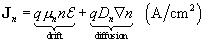
The current equation (2.35a) for electrons,
| (6.2a) | |
which is the sum of two terms, drift due to the field
and diffusion due to the concentration gradient. Similarly, for holes, we have
| (6.2b) | |
These two equations, under non-equilibrium condition, become [cf. Eq. (2.36)]
| (6.3a) | |
| (6.3b) | |
where ? n and ? p are the electron and hole quasi-Fermi potentials, respectively. The total current density J = J n + J p.
The continuity equations (2.38)
| (6.4a) | |
| (6.4b) | |
As was pointed out earlier, modeling a MOSFET is a 3-dimensional (3-D) problem but for all practical purposes (unless the width W and length L are very small), we can treat the system as a 2-D problem in the x and y direction only (see Figure 6.1). Even as a 2-D problem, the equations above are fairly complex; one could solve exactly only using numerical techniques,...