The drain current Eq. (6.14) includes both the drift and diffusion components of the current.
Assumption 6
Let us assume that the diffusion current is negligible so that all the current flow is due to drift only. This is a fairly good assumption provided the device is in strong inversion, that is, the gate voltage is greater than the threshold voltage ( V g s > V th). If the diffusion current is neglected then, from Eq. (6.2), it is easy to see that
| (6.38) | 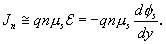
|
Comparing this equation with Eq. (6.7) we find that for a device in strong inversion, we can write
and therefore, from Eq (6.9) it follows that
| (6.39) | 
|
where ? s(0) is the surface potential at y = 0 (source end). For the sake of algebraic manipulation, it is more convenient to write
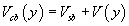
where V( y) now varies from 0 at the source end to V ds at the drain end. With this assumption, Eq. (6.39) can be rewritten as
| (6.40) | 
|
where we have replaced ? s(0) by 2 ? f, the classical criterion for strong inversion, while Eq. (6.14) reduces to
| (6.41) | 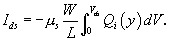
|
Thus, to calculate I ds we need to calculate Q i. We will now derive a simple and more useful expression for Q i using a charge balance equation given by Eq. (6.28). It is interesting to note that Eq. (6.41) can...


 TABLE OF CONTENTS