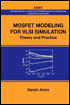
Mosfet Modeling For VLSI Simulation: Theory And Practice
Chapter 7: Dynamic Model

Overview

The MOS transistor DC models developed in the last chapter are applicable when applied voltages do not vary with time. In this chapter we will develop transistor dynamic models which are applicable when the device terminal voltages are varying with time. The variation in the applied voltages, if sufficiently small, results in the small signal model. However, if the variation in the voltages is large, the large signal model results. Both types of models are required for a circuit simulator, as was discussed in Chapter 1.

The dynamic behavior of a MOSFET is due to the device capacitive effects, which in turn are the results of the charges stored in the device. This is in addition to steady-state current (DC) as discussed in Chapter 6. The capacitive characteristics are in fact the sum of the intrinsic (channel region) and extrinsic (source/drain junction region) capacitances as discussed in section 3.2. Of key importance in calculating the MOSFET capacitances is an accurate description of the various charges in the device and how they depend on externally applied voltages. These capacitances are an essential part of the large signal as well as small signal model for frequencies of operation greater than about 1 KHz.

In this chapter we will first develop models for the intrinsic charges and capacitances of a large and wide MOSFET and then discuss models for short channel devices. This will give us the so called large signal model. This will be followed by small signal linear...

UNLIMITED FREE
ACCESS
TO THE WORLD'S BEST IDEAS

SUBMIT
Already a GlobalSpec user? Log in.

This is embarrasing...

An error occurred while processing the form. Please try again in a few minutes.

Customize Your GlobalSpec Experience

Category: RF MOSFET Transistors
Finish!
Privacy Policy

This is embarrasing...

An error occurred while processing the form. Please try again in a few minutes.