Mosfet Modeling For VLSI Simulation: Theory And Practice

In the discussion so far we have assumed that device lengths and widths are large so that edge effects can be neglected. However, when the device physical dimensions are reduced, the following distinct features are observed in the device characteristics:
The drain current I ds increases with drain voltage V ds beyond V d sat. That is, the slope of I ds - V ds curve increases from zero for long channel devices to some positive number for shorter devices. The shorter the device, the higher the slope. These devices also exhibit a softer breakdown that is not seen in long channel devices. Historically, this phenomena was thefirst short-channel effect to be studied.
The threshold voltage V th shifts from its long channel value. In other words, it becomes geometry dependent. In addition, the short-channel V th becomes drain voltage dependent due to the drain induced barrier lowering (DIBL) effect. Short-channel and narrow-width threshold voltage behavior were discussed in Chapter 5.
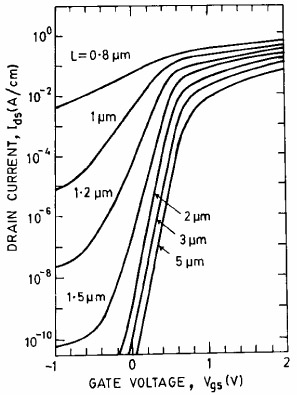
The subthreshold slope increases as the device becomes shorter (see Figure 6.26) [80]. In fact, when the device becomes very short, the gate no longer controls the drain current and the device can not be turned off. This is caused by the punch-through effect (cf. section 3.1). In addition, the subthreshold slope changes with the drain voltage.