Mosfet Modeling For VLSI Simulation: Theory And Practice
6.2: Pao-Sah Model

6.2 Pao-Sah Model

In this model Q i( y) is calculated numerically by integrating the electron concentration in the x direction. Equation (6.12) can be rewritten as

(6.15)

where ? s is the surface potential ( ? = ? s at x = 0) and is position dependent due to the voltage applied between the source and drain terminals. Note the lower limit of integration is ? f. This is because electron charge comes mostly from the area where electron concentration exceeds the hole concentration, the inversion layer therefore ends at a point where ? = ? f. In the equation above is the field in the x direction and is obtained by solving the Poisson equation (6.5). In analogy with an MOS capacitor [cf. Eq. (4.47)], the Poisson equation for a MOSFET can be written as

(6.16)

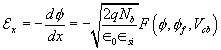
The only difference between Eq. (6.16) and the corresponding Eq. (4.47) for the MOS capacitor is the presence of the potential V cb( y) in the exponent and the position dependence of ?( y) in the y direction [cf. Eq. (6.10)]. Integrating Eq. (6.16) in the x direction, and following the same procedure as was used in solving Eq. (4.47), we get the field in silicon for the case of a MOSFET as

(6.17)

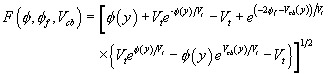
where

(6.18)

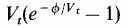
is essentially a function describing the electric field in which the term is contributed by the majority...

UNLIMITED FREE
ACCESS
TO THE WORLD'S BEST IDEAS

SUBMIT
Already a GlobalSpec user? Log in.

This is embarrasing...

An error occurred while processing the form. Please try again in a few minutes.

Customize Your GlobalSpec Experience

Category: Metal-Oxide Semiconductor FET (MOSFET)
Finish!
Privacy Policy

This is embarrasing...

An error occurred while processing the form. Please try again in a few minutes.