Mosfet Modeling For VLSI Simulation: Theory And Practice

The analysis so far was very general. No assumption was made for the thickness of the inversion layer and it was assumed that both holes and electrons exist in the depletion region. Let us now assume the inversion layer to be of zero thickness (i.e., simply a sheet of charges) so that no potential is dropped across it. [3] Let us further assume that the depletion region under the gate is practically free of mobile carriers so that the depletion approximation is valid. This means that the mobile charge density Q i is due to the inversion or channel region charge only, and is often referred to as inversion charge density.
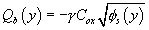
The bulk charge density Q b can be calculated as [see Eq. (6.15)]
| (6.25) | |
Assuming depletion approximation, the above integral can be approximated as
| (6.26) | |
where we have made use of Eq. (6.21) for ?. Similar to the case of an MOS capacitor, one can also derive the following expression for Q b, under the depletion approximation [cf. Eq. (4.29)],
| (6.27) | |
assuming an abrupt depletion layer boundary. The above equation is within 3% of Eq. (6.26) for the bias range of interest. It is this equation for Q b which we will use in rest of this chapter. Noting that the induced charge Q s in the channel is the sum of the inversion or channel charge Q i, and the bulk charge Q b