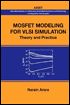
Mosfet Modeling For VLSI Simulation: Theory And Practice
In this chapter we will discuss the pn junction diode and MOSFET models, as implemented in Berkeley SPICE2G and higher versions. No attempt will be made to derive the model equations, as that has already been done at appropriate places in previous chapters. Here we will only describe equations used to model different regions of device operation. Emphasis will be on model parameters required to run SPICE and how to measure them.
Berkeley SPICE has four different MOSFET models of varying complexity and accuracy [1] [3]. These are (1) the Level 1 model a first order model suitable only for long channel devices; (2) the Level 2 model that includes various second order effects present in small geometry devices, and is considered to be a physical model; (3) the Level 3 model a semi-empirical model that includes most of the second order effects described in the Level 2 model; (4) the Level 4 model, called the BSIM (Berkeley Short-channel Igfet Model), that is a parameter based model. These different models can be activated by a parameter called LEVEL. We will describe all four levels of MOSFET model equations and their parameters. However, first we will describe the diode model parameters and how to determine them.
The SPICE diode model has been discussed in detail in section 2.9. Table 11.1 shows model parameters that determine both DC and AC characteristics of a diode.
| Parameter name in the text | SPICE parameter name | Parameter description |
|---|