Theoretical Nuclear And Subnuclear Physics, Second Edition
Quantum chromodynamics (QCD) is the theory of the strong interactions binding quarks and gluons into observed hadrons (baryons and mesons), and, in turn, into observed nuclei. As such, it is truly the theory of the structure of matter. A brief introduction to QCD was given in chapter 19. In this part of the book we turn our attention to developing the implications of the theory of QCD. Of particular interest is the strong-coupling regime appropriate to nuclear physics. First, however, it is necessary to further develop a basic understanding of the theory. We do that in this chapter with a review and summary, starting with the classic work of Yang and Mills on nonabelian local gauge theories [Ya54] (see also [Ab73]).
Start with isospin invariance [ SU(2)], which is the case originally studied by Yang and Mills [Ya54]. A discussion of isospin invariance is contained in chapter 21. In direct analogy with angular momentum, the isospin operator
is the generator of isospin transformations, and the operator
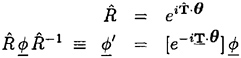
producing the finite, global isospin transformation through the angle ?=n ? is obtained through exponentiation. Its effect on the field
depends on the particular isospin representation to which that field belongs.
| (27.1) | ![]() |
Here T is a hermitian matrix representation of the generators
. [1]
is a column vector composed of a set of fields that mix among themselves under isospin transformations. Two examples consist of the previously studied nucleon and pion...