Theoretical Nuclear And Subnuclear Physics, Second Edition
Chapter 28: Path Integrals

Overview

Nuclear physics is the study of the structure and dynamics of hadronic systems. Such systems are composed of a confined quark/gluon substructure. The large-distance confinement of color, and the evolution into the large-distance hadronic structure, is governed by a regime where the coupling constant g is large and the nonlinear interactions of QCD are crucial. A central goal of nuclear physics is to deduce the consequences of QCD in this strong-coupling regime. [1] The subsequent developments are most conveniently presented in terms of a path integral formulation of quantum mechanics and field theory [Fe65]. This approach permits one to readily incorporate explicit local gauge invariance, and as a formulation of field theory in terms of multiple integrals over paths, provides a basis for carrying out large-scale numerical Monte Carlo evaluations of physical quantities. We start the discussion with a review of the basic concepts of path integrals. The material in this section is taken from [Fe65, Ab73] and [Se86, Wa92]; it is meant as a review. We start with the problem of a single nonrelativistic particle in a potential.

[1]As opposed to the very short-distance, high-momentum regime where one can do perturbative QCD.

28.1 Propagator and the Path Integral

The quantum mechanical amplitude for finding a particle at position q f at time t f if it started at q i at time t i is given by [2]

(28.1)

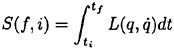
The action appearing in this expression is defined by

(28.2)

Here

UNLIMITED FREE
ACCESS
TO THE WORLD'S BEST IDEAS

SUBMIT
Already a GlobalSpec user? Log in.

This is embarrasing...

An error occurred while processing the form. Please try again in a few minutes.

Customize Your GlobalSpec Experience

Category: Q-switches
Finish!
Privacy Policy

This is embarrasing...

An error occurred while processing the form. Please try again in a few minutes.