Theoretical Nuclear And Subnuclear Physics, Second Edition

The material in this chapter is based on [Wi74, Cr83, Re83, Kh89]. We start by reviewing the motivation. The goal is to solve a locally gauge-invariant, nonabelian, strong-coupling field theory. We seek to understand confinement in QCD and the structure of hadrons and nuclei. Since it is the local gauge invariance that dictates the nature of the nonlinear couplings in the lagrangian, and since it is these nonlinear couplings that are presumably responsible for confinement, it is important that the approach incorporate local gauge invariance.
The method of solution, due to Wilson [Wi74], puts the theory on a finite lattice of space-time points with separation a. This reduces the problem to a large, but finite, set of degrees of freedom. A natural momentum cut-off of ??1/ a now appears in the theory. Various expectation values, which allow one to probe the consequences of QCD, can be related to the partition function. The resulting path integral ratios can be evaluated numerically with Monte Carlo techniques in some cases, such as mean-field theory and strong-coupling theory, analytic results can be obtained. At the end, the continuum limit must be taken (or at least discussed). Asymptotic freedom, whereby the renormalized coupling constant becomes vanishingly small at short distances [Eq. (27.53)], facilitates the continuum limit and permits one to tie on to perturbative QCD.
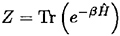
Recall from chapter 28 that the canonical partition function is defined by
| (29.1) | |
The energy of the system is then given by [see...