Theoretical Nuclear And Subnuclear Physics, Second Edition
Part 5: Appendices

Chapter List

Appendix A: Part 1
Appendix B: Part 2
Appendix C: Part 3
Appendix D: Part 4

A.1 Meson Exchange Potentials

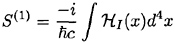
Consider the lowest-order scattering operator in nonrelativistic potential scattering

(A.1)

In second quantization the interaction hamiltonian with a potential V eff and distinguishable fermions is given by

(A.2)

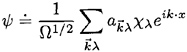
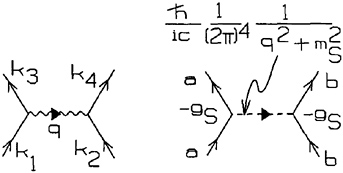
The kinematic situation is illustrated in Fig. A1.1. That part of the nonrelativistic field operator that contributes to the matrix element is the following

(A.3)

Here ? is the quantization volume. The matrix element of the scattering operator for the situation illustrated in Fig. A1.1 thus takes the form

(A.4)

where . Here spin indices have been suppressed.


Fig. A1.1: Kinematics for scattering, and scalar meson exchange.

The interaction lagrangian density for scalar meson exchange is given by

(A.5)

The Feynman rules (Fig. A1.1) then yield the following lowest-order S-matrix

(A.6)

The limit M ?? represents static sources; in this limit q 0= O(1/ M) and u u ? ? ss ?. A comparison of Eqs. (A.4) and (A.6) then allows the identification

(A.7)

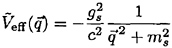
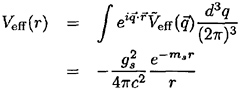
Note the sign. The Fourier transform of this relation then yields the celebrated Yukawa potential

(A.8)

Here all masses are in units of inverse Compton wavelengths mc/?.

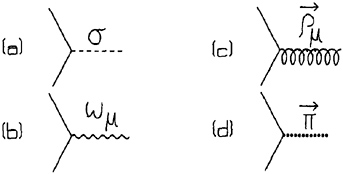
We summarize the effective potentials obtained in this fashion from various meson exchanges and lagrangian densities. The respective vertices are indicated pictorially in Fig. A1.2.


Fig. A1.2: Pictorial representation of vertices for various types of meson exchange: (a) neutral scalar ?;

UNLIMITED FREE
ACCESS
TO THE WORLD'S BEST IDEAS

SUBMIT
Already a GlobalSpec user? Log in.

This is embarrasing...

An error occurred while processing the form. Please try again in a few minutes.

Customize Your GlobalSpec Experience

Category: Ion Selective Electrodes
Finish!
Privacy Policy

This is embarrasing...

An error occurred while processing the form. Please try again in a few minutes.