Theoretical Nuclear And Subnuclear Physics, Second Edition

Equations (29.42) summarize the content of lattice gauge theory for QED in 1+1 dimensions; they are a self-contained set of expressions. In this section we solve those equations analytically under certain simplifying assumptions to get some physical insight into their implications. We work in mean field theory (MFT) where the basic idea is to reduce the coupled many-body problem to a one-body problem in a mean field coming from the average interaction with all the other degrees of freedom.
Although the exact problem clearly becomes more complicated, it is possible to carry out the MFT in any number of dimensions. In fact, one expects MFT to become more valid as the number of nearest neighbors increases. We first need some elementary considerations in different numbers of dimensions d.
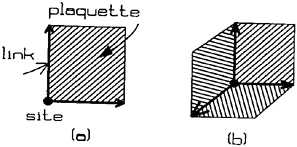
As an aid in the counting, divide the lattice into basic building blocks from which the entire lattice can be constructed by simple repetition. In two dimensions ( d=2), the elementary building block is the square, and in three dimensions ( d=3) it is the cube. This is easily seen (Fig. 30.1) and extended to d dimensions. At each site draw the positive orthogonal coordinate axes and place the building block between the positive axes. The site can then be associated in a one-to-one fashion with the origin of this coordinate system, and the lattice constructed by repetition of the basic building block at each site. Some elementary results then follow immediately.