Theoretical Nuclear And Subnuclear Physics, Second Edition

In this chapter we consider the calculation of observables in lattice gauge theory (LGT). These will include such quantities as: (1) the interaction potential between a static quark-antiquark pair, where a linear rise in the potential with separation distance will provide strong evidence for the complete screening of the strong color charge and the confinement of color; (2) the corresponding string tension, or force required to separate the two static color charges; and (3) the mass of a glueball, a particle without quarks arising entirely from the nonlinear gluon interactions. References [Wi74, Cr82, Cr83, Cr83a, Re83, Ko83, Be83, Be83a, Ot84, Ca89, La02] provide the relevant background; this section is based on [Ca89].
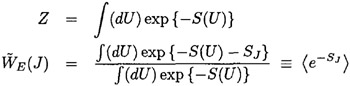
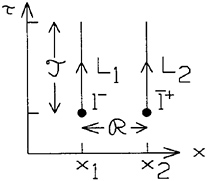
For clarity we start the discussion with the abelian U(1) theory and then generalize to the nonabelian case. Put a (heavy) charged lepton pair with charges e 0 at two fixed points in space with world lines as shown in Fig. 33.1. The charges interact through the electromagnetic field. The interaction with the background electromagnetic field can be included exactly in LGT. Consider the partition function and the generating functional for the gauge fields (chapters 28 and 29)
| (33.1) | ![]() |
Everything is now in the euclidian metric, and the correct boundary conditions are implied: for Z one takes