Overview
So far the discussion of lattice gauge theory has been based on a gauge-invariant treatment of the nonlinear boson (gluon) couplings in a Yang-Mills nonabelian local gauge theory. In this chapter we discuss the extension of LGT to include fermions (quarks). This chapter is based on [Wi74, Ko75, Ba76a, Su77, Wi77, Dr76, Dr76a, Ko83, Dm89, La03] much of it is taken from [Dm89].
The free Dirac lagrangian density is given by
| (36.1) | 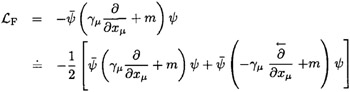 |
The second line is an equivalent form to be used in the action where a partial integration can be carried out.
In QED, a theory with U(1) local gauge invariance, the lagrangian density takes the form
| (36.2) | 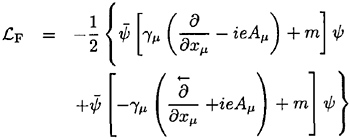 |
In the euclidian metric of LGT one calculates the action
| (36.3) | 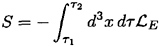 |
Here the four-vectors (x , A ) are taken as
| (36.4) | 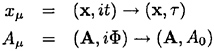 |
In analogy, for the Dirac gamma matrices in the euclidian metric we will make the replacement
| (36.5) |  |
Thus in the following we shall use
| (36.6) |  |

 TABLE OF CONTENTS