4.7. TETRAHEDRONS
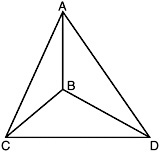
Definition. A tetrahedron is a figure bounded by four triangular faces. Thus, ABCD is a tetrahedron.
It has 4 faces, namely the ?s ABC, ACD, ADB and BCD.
It has 4 vertices, namely A, B, C, D ; each vertex being the point of intersection of three of the four planes.
It has 6 edges, namely the lines AB, AC, AD, BC, BD, CD ; each edge arising as the line of intersection of two of the four planes.
It has three pairs of opposite edges i.e., the edges which do not meet, namely AB and CD, BC and AD, CA and DB.
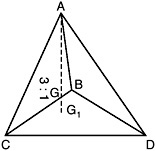
The centroid G of the tetrahedron ABCD divides the line joining any vertex to the centroid of its opposite face in the ratio 3 : 1
[ From Statics]
Thus, if G 1 is the centroid of ?BCD, then G, the centroid of tetrahedron ABCD divides AG 1 in the ratio 3 : 1. i.e.,  .
.


 TABLE OF CONTENTS