Advanced Engineering Mathematics: A Computer Approach, Seventh Edition

In this chapter, we shall study the applications of linear differential equations to various physical problems. Such equations play a dominant role in unifying seemingly different theories of mechanical and electrical systems just by renaming the variables. This analogy has an important practical application. Since electrical circuits are easier to assemble, and less expensive and accurate measurements can be made of electrical quantities, we construct equivalent electrical models of complicated mechanical systems to study their displacements. We shall also study the slightly less striking applications such as deflection of beams, whirling of shafts, and electrical transmission lines.
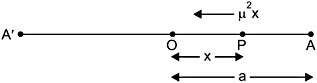
A particle is said to execute simple harmonic motion if it moves in a straight line such that its acceleration is always directed towards a fixed point in the line and is proportional to the distance of the particle from the fixed point.

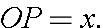
Let O be the fixed point in the line A ?A. Let P be the position of the particle at any time t, where
Since the acceleration is always directed towards O, i.e., the acceleration is in the direction opposite to that in which x increases, the equation of motion of the particle is ![]()
or
It is a linear differential equation with constant coefficients.
Its A.E. is D 2 + 2 = 0 so that D = i
? The soluation of (1) is
Velocity of particle at
If the particle starts...