Advanced Engineering Mathematics: A Computer Approach, Seventh Edition

Chapter 23: Z-Transforms

23.1. INTRODUCTION

The Z-transform plays an important role in the fields of communication engineering and control engineering at the stage of analysis and representation of discrete-time linear shift invariance systems. When continuous signals are sampled, discrete-time functions arise. The application of the Z-transform in discrete time systems is similar to that of the Laplace transform in continuous time systems.

23.2. DEFINITION OF THE Z-TRANSFORM

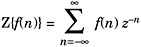
Let { f( n)} be a sequence defined for all positive integers n. Then the Z-transform of f( n) is defined as


where z is an arbitrary complex number.

This is a one sided Z-transform.

Notes :

  1. If { f( n)} is defined for n = 0, 1, 2, ...... then and is called a two sided Z-transform.

  2. If f( n) = 0 for n < 0 then { f( n)} is called a casual sequence.

  3. The bracket { } represents a sequence.

The infinite series on the R.H.S. of (1) will be convergent only for certain values of z depending on the sequence f( n). The inverse Z-transform of Z{ f( n)} = F( z) is defined as Z 1{F( z)} = f( n).

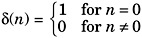
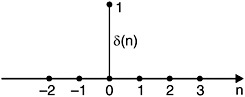
23.3. UNIT SAMPLE SEQUENCE

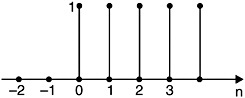
It is defined as

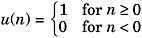
23.3.1. Unit Step Sequence

It is defined as

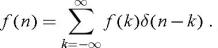
23.3.2. Relation between Unit Sample Sequence and Unit Step Sequence


We have


Also


23.4. THE...

UNLIMITED FREE
ACCESS
TO THE WORLD'S BEST IDEAS

SUBMIT
Already a GlobalSpec user? Log in.

This is embarrasing...

An error occurred while processing the form. Please try again in a few minutes.

Customize Your GlobalSpec Experience

Category: Analog-to-Digital Converters
Finish!
Privacy Policy

This is embarrasing...

An error occurred while processing the form. Please try again in a few minutes.