Advanced Engineering Mathematics: A Computer Approach, Seventh Edition

Chapter 18: The Laplace Transforms

18.1. INTRODUCTION

A transformation is a mathematical device which converts one function into another. For example, when the differential operator operates on f( x) = sin x, it gives a new function


The Laplace transform or Laplace transformation is widely used by scientists and engineers. It is particularly effective in solving linear differential equations ordinary as well as partial. It reduces an ordinary differential equation into an algebraic equation.

The Laplace transform quickly gives the solution of differential equations with given initial conditions without the necessity of first finding the general solution and then evaluating the arbitrary constants.

18.2. DEFINITION

Let f( t) be a function of t defined for all t ? 0. Then the Laplace transform of f( t), denoted by L{ f( t)}, is defined by


provided that the integral exists, s is a parameter which may be real or complex.

L{ f( t)} is clearly a function of s and is briefly written as f( s) i.e., L{ f( t)} = f( s).

18.3. THE LINEARITY PROPERTY

If c 1, c 2 are constants and f, g are functions of t, then


By definition,


The result can easily by generalized.

18.4. LAPLACE TRANSFORMS OF SOME ELEMENTARY FUNCTIONS


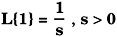
  1. , where n is a positive integer.


    provided that s > 0 and n + 1 > 0 i.e., n

UNLIMITED FREE
ACCESS
TO THE WORLD'S BEST IDEAS

SUBMIT
Already a GlobalSpec user? Log in.

This is embarrasing...

An error occurred while processing the form. Please try again in a few minutes.

Customize Your GlobalSpec Experience

Category: IC Electronic Filters
Finish!
Privacy Policy

This is embarrasing...

An error occurred while processing the form. Please try again in a few minutes.