Advanced Engineering Mathematics: A Computer Approach, Seventh Edition

Chapter 25: The Numerical Solution of Partial Differential Equations

25.1. INTRODUCTION

In engineering, science and many branches of applied mathematics ( e.g., in fluid dynamics, boundary layer theory, heat transfer quantum mechanics etc.), we often come across partial differential equations. But only few of them can be solved by analytical methods. So in most cases, we go in for numerical methods to approximate a solution. Of all the numerical methods available for the solution of partial differential equations, the method of finite differences is most commonly used. In this method, the derivatives appearing in the equation and the boundary conditions are replaced by their finite difference approximations. Then the given equation is changed into a system of linear equations which are solved by iterative procedures.

25.2. DIFFERENCE QUOTIENTS

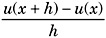
A difference quotient is the quotient obtained by dividing the difference between two values of a function, by the difference between the two corresponding values of the independent variable.

Thus for a function u( x) of a single variable the difference co-efficient is ,

whose limiting value is the derivative of u( x) w.r.t. x i.e., .

Here u( x, y) is a function of two independent variables x, y. ? We have to consider the differences in both.

First let us consider the differences in the x-direction.

The Taylor s series for u( x, y 0) about the point ( x 0, y 0) is


where x 0 ? ? ? x.

UNLIMITED FREE
ACCESS
TO THE WORLD'S BEST IDEAS

SUBMIT
Already a GlobalSpec user? Log in.

This is embarrasing...

An error occurred while processing the form. Please try again in a few minutes.

Customize Your GlobalSpec Experience

Category: Computational Fluid Dynamics Software (CFD)
Finish!
Privacy Policy

This is embarrasing...

An error occurred while processing the form. Please try again in a few minutes.