Advanced Engineering Mathematics: A Computer Approach, Seventh Edition

A differential equation which involves partial derivatives is called a partial differential equation.
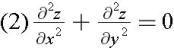
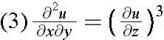
For example,
are partial differential equations.
The order of a partial differential equation is the order of the highest partial derivative in the equation. The degree of a partial differential equation is the degree of the highest order partial derivative occurring in the equation.
Thus, equation (1) is of first order, and equations (2) and (3) are of second order. The degree of all the above equations is one.
If z is a function of two independent variables x and y, then we shall use the following notation for the partial derivatives of z :
Partial differential equations can be formed either by the elimination of arbitrary constants or by the elimination of arbitrary functions. If the number of arbitrary constants to be eliminated is equal to the number of independent variables, the partial differential equations that arise are of the first order. If the number of arbitrary constants to be eliminated is more than the number of independent variables, the partial differential equations obtained are of second or higher order. If the partial differential equation is obtained by elimination of arbitrary functions, then the order of the partial differential equation is, in general, equal to the number of arbitrary functions eliminated.
The following examples illustrate the method.
Example 1. Form partial differential equations from the following equations by...