7.1. SCALARS AND VECTORS
In mathematics and physics, we generally deal with two types of quantities classified on the basis of two characteristics magnitude and direction. A quantity which is completely specified by its magnitude only is called a scalar. To specify a scalar, we need a unit and a real number. For example, time, mass, length, temperature, work, electric charge and statistical data are all scalar quantities. They obey all the laws of ordinary algebra.
A quantity which is completely specified by its magnitude as well as direction is called a vector. For example, weight, displacement, velocity, acceleration and force are all vector quantities.
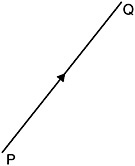
A vector is represented by a directed line segment. A vector whose magnitude is the length PQ and whose direction is from P to Q is denoted by  . P and Q are called the initial and terminal points of the vector . The magnitude of vector is denoted by and = PQ.
To distinguish vectors from scalars, bold face type is used for vectors e.g., A, B, a, b, PQ etc. Other notations used to denote a vector A are  , A,
, A,  .A and its magnitude (or length) is denoted by A or A.


 TABLE OF CONTENTS