Basic Math for Process Control
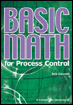
A practical tutorial on the mathematics essential to the process control field, this book is a handy reference for process control engineers and a helpful aid to students in mathematics courses.
 TABLE OF CONTENTS
 Mathematical relationships are constructed around variable quantities (called variables for short). The relationship shows the way that the value of one of the variables changes when the values of the other variables change.
This implies that in each relationship there is one variable whose value is dependent on the values of the other variables. It is consequently called the dependent variable, while the other variables are called the independent variables.
The way in which some mathematical relationships are structured often leaves doubt as to which of the variables is the dependent variable. The question becomes more difficult to answer as the number of variables in the relationship increases.
In the control systems engineering field, however, many relationships contain only two variables. Furthermore, one of the variables will be time (designated t). Since a unique characteristic of time is that it pursues its uniform and relentless course into eternity, unaffected by anything else, it is obvious that time cannot be dependent on any other physical variable. Consequently, in all control systems relationships that involve time, it must be the independent variable.
The relationships that are most common in control systems engineering generally show how some dependent variable, which could be distance, temperature, pressure, and so on, varies with time. If the dependent variable is represented by x, then it can be stated that "x is some function of time." In the shorthand of mathematics, this is written x = f (t).
Notice that what this shorthand relationship is...