Basic Math for Process Control
A practical tutorial on the mathematics essential to the process control field, this book is a handy reference for process control engineers and a helpful aid to students in mathematics courses.
 TABLE OF CONTENTS
 Integral calculus has as its basis the mathematical operation of integration, which is generally considered to be the reverse of the operation of taking the derivative of a function. What this means is that in some problems, the derivative dx/dt is known, and the requirement is to determine the original function f (t) for which dx/dt is the derivative. This can often, though not always, be done through integration.
Integration is always performed on the differential of a variable. The quantities dt and dx are the differentials of the variables t and x, respectively. If the relation x = f (t) is given, then the function of t, which is obtained by evaluating the derivative dx/dt, is customarily designated f ?(t). That is,

The relationship between the differentials of x and t, (dx and dt), is consequently
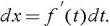
Differentiation is the process of obtaining the differential of a function. Integration, the inverse operation, involves obtaining the original function from the differential. The integration operation is flagged by the ? integration sign.
In mathematical symbology, dx = f ?(t) dt identifies the differentiation operation, while ?f ?(t) dt = f(t) = x identifies the operation of integration.
Integration differs from differentiation in one notable respect while it is always possible to differentiate any function involving the independent variable, it is not possible to integrate all such functions. Certain functions cannot be integrated. This is because although every function has a derivative, not every...