Basic Math for Process Control
A practical tutorial on the mathematics essential to the process control field, this book is a handy reference for process control engineers and a helpful aid to students in mathematics courses.
 TABLE OF CONTENTS
 There is an area of mathematics that deals with equations that contain derivatives of a variable with respect to another variable, or variables. These equations are called differential equations. The following are examples.

The solution of a differential equation requires that an equation be obtained that has the variables in their natural form, that is, free of all derivatives. In the case of the first example above, the solution is:
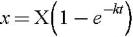
This solution can be verified. If it is actually the original relation between x and t, then taking the derivative with respect to t of both sides gives

Then the left side of the differential equation equals

which is the right side of the equation.
In many cases, a set procedure cannot be established for the solution of a particular differential equation. In fact, many differential equations, principally those that lack a certain degree of symmetry or orderliness, are incapable of solution. Solving differential equations is often as much an art as it is a science. Mathematical intuition and experience are valuable assets.
Solvable differential equations tend to fall into patterns, so that part of the skill required to solve a differential equation lies in being able to spot the pattern and in knowing the right procedure for dealing with it.
As an example, the motion of a mass suspended from a spring and caused to bounce up and down can be described by the differential equation in Example (2). Observing the motion of the mass reveals, first...