Basic Math for Process Control
A practical tutorial on the mathematics essential to the process control field, this book is a handy reference for process control engineers and a helpful aid to students in mathematics courses.
 TABLE OF CONTENTS
 A quadratic equation involving the variable "x" can be written in its general form and can then be solved using an algebraic procedure. The general form of the quadratic equation in x, is

Because of the quadratic (second power) nature of the equation, two values of x will satisfy it. These values of x are called, in mathematical parlance, the "roots of the equation." They can be designated m 1 and m 2, and their values are

The solution for any quadratic equation can consequently be found by applying this formula for m 1 and m 2. For example, given that
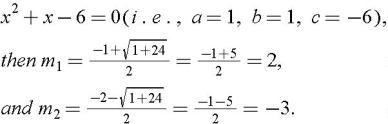
Therefore, x = 2 and x = ?3 are the solutions for x 2 + x ?6 = 0.
The determination of the roots of a quadratic equation is straightforward, provided that the quantity under the square root sign (b 2 ? 4ac) does not turn out to be negative, as it would if the equation to be solved were

In this case,

The term ? ?16 can be simplified one step further by taking the factor 4 outside of the square root sign, leaving only the factor ( ?1). That is, ? ?16 = 4 ? ?1. The roots of the equation then become

This introduces the concept of a "number" whose value is ? ?1. This number will be identified by the letter j, that is, j = ? ?1. Since ?