Basic Math for Process Control
A practical tutorial on the mathematics essential to the process control field, this book is a handy reference for process control engineers and a helpful aid to students in mathematics courses.
 TABLE OF CONTENTS
 The standard deviation is a number developed by statisticians to indicate the extent of the dispersion of the readings around the arithmetic mean. The standard deviation is not the same as the average deviation, although the average deviation is involved in the calculation of the standard deviation.
Assuming that the average deviation AD has been determined as described already, then the standard deviation SD is equal to
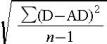
This is the abbreviated version, in which ? is the summation operator, D stands for the deviations of the individual readings from the AM, AD is the average deviation, and n is the number of readings. In the long form,

For the gasoline price situation, the standard deviation computes to be 1.7.
Statistically, all of the readings that were involved in the calculation should be not more than three times the standard deviation different from the arithmetic mean. If any individual reading has a deviation greater than this from the AM, it is assumed to be invalid and it is scrubbed from the list. The calculation is then redone, from the start, using the remaining readings. This will generate a new value for the standard deviation and will require a second check of the validity of the readings. For the example, all 15 readings were within 3 1.7 = 5.1 / l of the AM, 65.2 / l, and are accordingly accepted as valid.
The statistical significance of the standard deviation is that of all of the readings...