Basic Math for Process Control
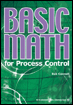
A practical tutorial on the mathematics essential to the process control field, this book is a handy reference for process control engineers and a helpful aid to students in mathematics courses.
 TABLE OF CONTENTS
 It often happens that the most representative value (MRV) for a particular entity has to be determined from a number of measurement readings, with the added complication that not all of the readings are the same. Differences in the readings can occur for a number of reasons.
The entity varies from time to time, as in the case of gasoline prices, or the outdoor temperature, but one reading has to be selected for the MRV to make cost or other projections.
Not all of the readings are taken by the same person, and there is a question of skill involved.
Not all of the readings are taken using the same type or quality of equipment, and there is a question of the potential error or the reliability.
The result is that when one number is designated to be the MRV out of a group of readings representing the same entity, the question then arises: How much assurance can one have in the accuracy of the MRV?
A possible answer lies in determining how closely the various readings are grouped around the MRV, or conversely, how badly they are scattered. In this procedure, the MRV is, by definition, the arithmetic mean (AM) or average. For the set of gasoline prices (P1 to P15), the AM is 65.2 / l. The deviations of the individual readings are designated D1, D2, D15, where

All deviations (D1 to D15) are considered to be positive...