Basic Math for Process Control
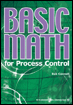
A practical tutorial on the mathematics essential to the process control field, this book is a handy reference for process control engineers and a helpful aid to students in mathematics courses.
 TABLE OF CONTENTS
 It sometimes happens that a function f(t) of the variable t appears as the sum of a number of terms, each of which in itself is a function of t. One such example is

This type of function can become useful under the following circumstances.
There is no limit to the number of terms.
The format of the terms follows a discernible pattern.
In other words, if n designates the number of an individual term in the function (n = 1, 2, 3, 4, etc.), then a formula for the general, or n th, term can be written. In the example above, the n th term is n sin ( ?t) n.
If these two conditions are met, the function f(t) is called an infinite series.
An infinite series will often prove productive if it is the type for which the sum of the terms never exceeds a certain finite limit, no matter how many terms are added on. A series of this type is said to be convergent. An infinite series whose sum eventually becomes infinite as more and more terms are added is called divergent.
For example, the infinite series

may be convergent or divergent, depending on the value of t. If t = 1, then the sum goes to infinity as the number of terms becomes larger. If t < 1, however, the sum will be limited to a definite finite number, no matter how many terms are included. If...