Basic Math for Process Control
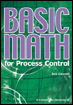
A practical tutorial on the mathematics essential to the process control field, this book is a handy reference for process control engineers and a helpful aid to students in mathematics courses.
 TABLE OF CONTENTS
 Feedback control systems are made up of components that are reactive by nature. This means that each one has an input (sometimes more than one) and the means to generate an output. The inputs and outputs have a variety of forms, but in process control the most common are process variables and instrument signals.
To be usable, the output of a component must exhibit a consistent relationship to its input. Output relationships are not necessarily neat and tidy, but the same input must consistently produce the same output; otherwise the component is unacceptable.
Control systems experts need techniques to determine and describe how the components of a control system will perform. If the behavior of the individual components that make up the system can be identified, then the behavior of the overall system can be evaluated.
This leads to the question: What kind of behavior are we interested in? There are two factors:
The gain of the component. If the input to the component is changed a known amount, how much does its output change? The gain factor will be the ratio of the change in output to the change in the input that created it. The output change is measured as it goes from the initial steady state value to the final steady state value. Time is not a factor. The output is permitted all the time that is necessary to assume its new value.
A further consideration is whether or not the gain of the component remains...