This introductory chapter to the CNC Programming Techniques presents the most basic technique of all how to develop a part program in an organized way. Its purpose is to present an engineering drawing, evaluate it and develop all procedures required to write the final program.
In strict terms, program development using a step by step procedure is not the most appropriate approach, because it suggests finish step 1 before starting step 2 . That is never the case in CNC programming, as many steps interact with each other. For example, a change in setup may influence the tooling selection, width or depth of cut, etc. Keep this in mind when studying this chapter.
Program Development Drawing
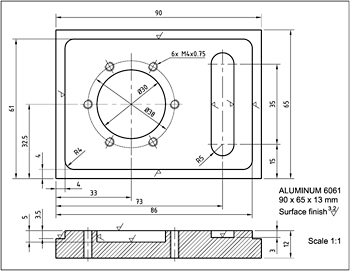
The drawing below will be used throughout the chapter, including required details, calculations, all complete with explanations of individual steps required in the CNC program development. The drawing includes some of the most common machining operations face cutting, machining holes, contouring, circular pocket, and a slot milling. The design has been kept intentionally simple.
Drawing Evaluation
The first thing a CNC programmer should always do before writing the program, is to evaluate the drawing in order to get a general idea about the part. Such an evaluation includes several observations that can be summed up:
-
Drawing units and scale
-
Dimensioning method
-
Tolerances
-
Material type, size, shape and condition
-
Surface finish requirements
-
Title block information
-
Drawing revisions
-
Bill of Materials (BOM) if available
-
Omissions and other...
Copyright Industrial Press Inc. 2005 under license agreement with Books24x7


 TABLE OF CONTENTS