CNC Programming Techniques: An Insider’s Guide to Effective Methods and Applications

Tool Retract Techniques Lead-Out

Series of tool motions programmed after the last element of the contour had been machined is called tool retract or lead-out motion. In many ways, the methods and suggestions for the lead-out motions are similar to the lead-in methods. The major considerations are as before the cutter radius offset and sufficient clearances.

Retract from a Face

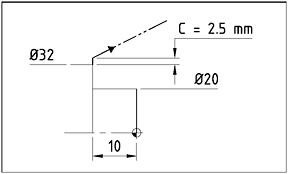
If the last element of the contour is a face (also called a shoulder, if it is in the middle of a contour), the retract is very simple, and there are no special considerations required. All that is needed is to continue the face cutting into the air into a X-axis clear position (clearance diameter).

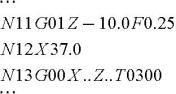
The following program illustrates the method.

  • Example:


Note the retract diameter although the part diameter is only 32 mm, another 2.5 mm per side has been added as a standard procedure.

Retract from a Diameter

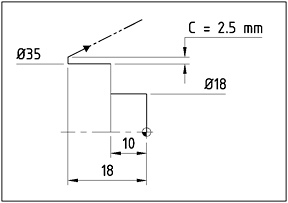
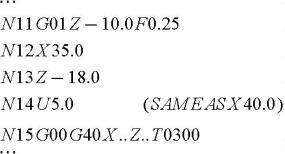
When the last element of a contour is a diameter (specified by the X-axis only), program any tool retraction along the X-axis first, before moving away from the part. This X-motion should always be minimum of 2.5 mm (or 0.1 inches) per side (5 mm or 0.2" on diameter). As mentioned several times before, this clearance is necessary to accommodate the three standard tool nose radius sizes 0.4, 0.8, and 1.2 mm (0.0156, 0.0313, and 0.0469 inches).

  • Example:


Note the block N14 it uses an incremental amount of motion, rather than absolute dimension. Either one can be used,...

UNLIMITED FREE
ACCESS
TO THE WORLD'S BEST IDEAS

SUBMIT
Already a GlobalSpec user? Log in.

This is embarrasing...

An error occurred while processing the form. Please try again in a few minutes.

Customize Your GlobalSpec Experience

Category: Boring Tools
Finish!
Privacy Policy

This is embarrasing...

An error occurred while processing the form. Please try again in a few minutes.