CNC Programming Techniques: An Insider’s Guide to Effective Methods and Applications

Although the subject of subprograms has been used in applications described in other chapters, it is a subject too important to leave it at that level only. In this chapter, specially designed for the subject of subprogram development, all logical steps will be explained on actual examples.
In the simplest terms, a subprogram is a program segment that runs under another program. While quite true, the simple definition falls short of explaining the purpose and need of subprograms in CNC programming. Subprograms are used for a number of reasons two most important reasons are:
Overall length of the part program is smaller
Changes to toolpath related data are much easier to make
There are other benefits as well. Subprograms are very powerful tool for CNC programming. They can be used in absolute or incremental mode, called by any program, and they can even be nested, which means one subprogram calls another subprogram, up to four levels deep on most controls. The best way to understand subprogram development is to work with an example:

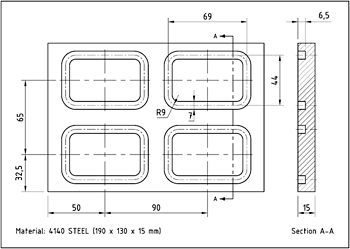
In the drawing, there are four identical grooves, at four different locations. That means there are four identical patterns that have to be translated into a suitable toolpath used with one or more cutting tools. Each groove is defined by its centerline length (69 mm), its centerline width (44 mm) and its total depth (6.5 mm). When studying this or a similar drawing, it is also important to identify...