CNC Programming Techniques: An Insider’s Guide to Effective Methods and Applications

Corner Radius and Back Angle Selection

CNC programmers do not directly include the tool nose radius in the program, as the toolpath uses drawing dimensions and the actual radius is handled by cutter radius offset. That does not mean the programmer should totally ignore the corner radius or even the back angle of the selected tool.

The most commonly used corner radiuses for turning and boring are 0.4 mm, 0.8 mm, and 1.2 mm or their Imperial equivalents of 1/64, 1/32, and 3/64. The middle size (0.8 mm or 1/32 inch) is the most common radius used, but that also depends on the machine size and the type of work. Typically, larger radiuses (up to 1.6 mm or 1/16 inch) are common for large CNC lathes with higher power rating. Large radiuses are also selected for heavy work on castings and forgings, to minimize tool wear. In addition, it is not just the nose radius itself that has to be considered, but the insert size as well. The larger the inscribed circle of the insert (as per tooling catalog), the heavier cut may be taken, providing the machine has enough power to handle it (power is measured in kW or HP).

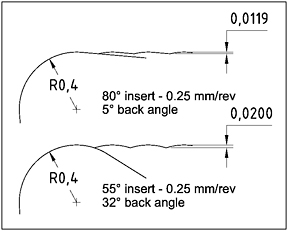
The above illustration shows an example of a 80 insert with 0.4 mm radius (0.0156 inch) and a 5 back angle, as well as a 55 insert, also with a 0.4 mm radius but 32 back angle. At the common feedrate of F0.25 mm/rev (0.0984 in/rev), note the depth...

UNLIMITED FREE
ACCESS
TO THE WORLD'S BEST IDEAS

SUBMIT
Already a GlobalSpec user? Log in.

This is embarrasing...

An error occurred while processing the form. Please try again in a few minutes.

Customize Your GlobalSpec Experience

Category: Cutting Tool Inserts
Finish!
Privacy Policy

This is embarrasing...

An error occurred while processing the form. Please try again in a few minutes.