CNC Programming Techniques: An Insider’s Guide to Effective Methods and Applications

By established standards, planes in CNC environment are related to mathematical planes. A plane is typically defined as a two-dimensional area bounded by two known lines or a single known arc . A plane can also be defined by three points that do not lie on a single line. Any plane can be rotated or translated in space. In two-dimensional machining (2D), a plane is defined by any two standard axes (XYZ) and is programmable using preparatory commands (G-codes). In three-dimensional machining (3D), a plane can be set at any orientation and is not programmable. However, any plane can be defined in a CAM system for 3D work.
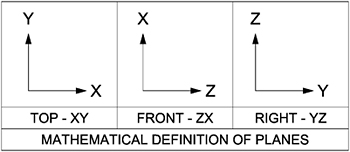
As there are three axes named X, Y and Z, a mathematical plane is defined by any two axes combined, using the same letters. There is a standard international convention that dictates the definition of mathematical planes.

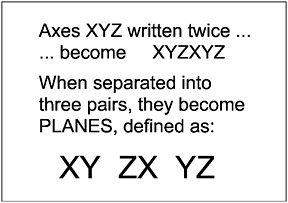
The best way to remember their exact definition, is to write down the three axes twice in a row without spaces, one after each other, and separate the resulting six letters into three pairs see illustration.
Planes are defined by axes in their positive direction.
Understand the mathematical planes first before defining the machine planes.

Mathematical planes are always identified by positive axis direction, whereby the first letter of the definition represents the horizontal axis, and the second letter represents the vertical axis of the selected plane.
For example, in the YZ plane, the letter Y represent the horizontal axis, letter Z the...