Cooling and Heating Load Calculation Principles

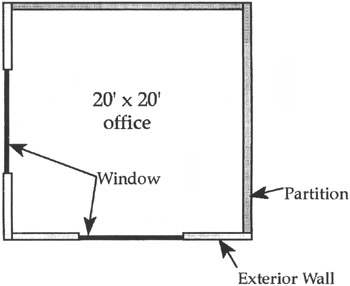
A small single-story office building is used to illustrate the use of the heat balance procedures. A 20 ft by 20 ft zone, which represents the southwest corner of this office building, is shown schematically in Figure 3.1.
Heat balance-based calculations can be approached systematically by considering the information that is required by each of the three energy balances: outside, inside, and air. A step-by-step procedure that follows this approach is described in the following sections. The procedure organizes the information in the format of the heat balance-based program supplied with this manual.
The heat balance procedure is based on a 24-hour calculation. This requires hourly values for many or most design parameters. These hourly values can be generated by functional relationships, such as sinusoidal outdoor temperature profiles, but the straightforward approach is to simply supply the 24 values when required.
The daily hourly values for the outdoor air dry-bulb and the outdoor air wet-bulb temperatures are the two critical outdoor parameters as shown in Table 3.1. The temperatures represent design weather conditions for the location of the building.
| Local Time | 1:00 | 2:00 | 3:00 | 4:00 | 5:00 | 6:00 | 7:00 | 8:00 | 9:00 | 10:00 | 11:00 | 12:00 | |
|---|---|---|---|---|---|---|---|---|---|---|---|---|---|
| Outside Conditions | |||||||||||||
| Outside Air Dry-Bulb Temperature, F | AM | 76.0 | 76.0 | 75.0 | 74.0 | 74.0 | 74.0 | 75.0 | 77.0 | 80.9 | 83.9 | 80.0 | 87.0 |
| PM | 93.0 | 94.0 | 95.0 | 94.0 | 93.0 | 91.0 | 87.0 | 85.0 | 83.0 | 81.0 | 79.0 | 77.0 | |
| Outside... |