Cooling and Heating Load Calculation Principles

The building location determines the outside weather conditions, the incident solar angles, and, by extension, the total zone solar heat gain. The building used in the base case example was located in Champaign, Ill., at 40 N latitude. Consider the same building located in Dallas, Texas. The outside dry-bulb and wet-bulb temperature were adjusted to reflect the change in daily high and the range between Champaign and Dallas.
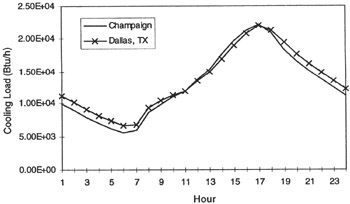
Although the daily high outdoor dry-bulb temperature changed from 95 F in Champaign, to 102 F in Dallas, the change in the cooling load is insignificant as shown in Figure 3.10. The outdoor dry-bulb temperature difference, in fact, changes by only 7%, but the more important factor is the conductive heat gain, which for this building is a small fraction of the total heat gain. For cases where conductive heat gains are more significant, the effect of location will have a greater impact on the cooling load.