Cooling and Heating Load Calculation Principles

3.5: Changing Wall Constructions

3.5 Changing Wall Constructions

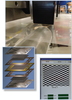
The ASHRAE heat balance methods describe walls, roofs, and floors as "multi-layered slabs." The material properties of each layer are described from outside to inside as shown in Table 3.6 Specifying new layer properties changes both the heat storage capacity of the surface and the heat transfer rate through the surface. Although the input parameters can be changed with relative ease, the effects produced by these changes can only be accounted for by a computation. The complexity in the computational procedure, which is described in detail in Chapter 10, arises because of the time-dependent nature of the calculation.

3.5.1 The Effect of Building Mass

The walls of the corner office zone described in the base case are constructed of a brick facing followed by 3 in. of insulation, 5 in. of lightweight concrete block, and 3/5 in. of plaster. The interior walls are 8 in. of lightweight concrete block. The roof is 5 in. of poured concrete with an airspace and acoustic tile. To answer the question of how thermal mass affects this building, the density of each material layer will be changed to the extreme conditions of purely resistive layers and extremely dense layers. This is specified by changing the density of each layer without changing any other layer parameters (Table 3.6).

Thermal mass tends to dampen and shift the peak load. This effect is especially pronounced in zones with a significant fraction of total heat gains contributed by conduction and solar radiation. At the...

UNLIMITED FREE
ACCESS
TO THE WORLD'S BEST IDEAS

SUBMIT
Already a GlobalSpec user? Log in.

This is embarrasing...

An error occurred while processing the form. Please try again in a few minutes.

Customize Your GlobalSpec Experience

Category: Retaining Walls
Finish!
Privacy Policy

This is embarrasing...

An error occurred while processing the form. Please try again in a few minutes.