This chapter covers two general classifications of parts: (1) parts identical or similar to the screw-machine products covered by Chap. 4.3 when those parts are made on equipment other than automatic screw machines and (2) all other components requiring turning or other operations performed on lathes and lathe-type machines.
TURNING PROCESSES
Turning is a conventional material-removal operation that produces surfaces of rotation on the workpiece. Like other machining operations, turning removes material by the shear process to produce the desired shape, size, and surface finish. It is generally accomplished by causing cutting tools, varying in geometry and working separately or simultaneously, to move in a precise path with respect to a rotating workpiece. Workpieces, generally made of metal in the form of bars, tubes, castings, and forgings, are held by means of chucks, collets, and centers. The workpiece rotates about its center axis and the centerline of the machine spindle.
Common cutting-tool modes on turning equipment are shown in Fig. 4.4.1. They include facing, straight turning, taper turning, grooving, cutoff, threading (single-point threading is shown in Fig. 4.4.1; other thread-cutting operations described in Chap. 4.8 for both internal and external threads are commonly carried out on turning equipment), tracer turning (form turning, as described in Chap 4.3, is also common), drilling, reaming, and boring.
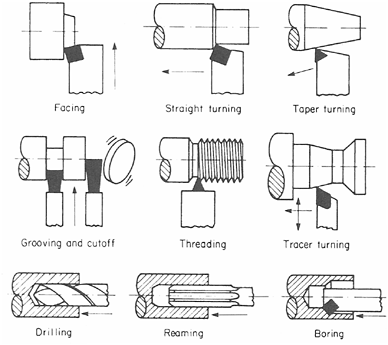 Figure 4.4.1: Basic operations performed on turning equipment.
 In tracer turning, the single-point cutting tool, as it traverses the work, moves inward and outward in...

 TABLE OF CONTENTS


