THREAD SYSTEMS
Figures 4.8.1 through 4.8.6 illustrate common thread forms.
The unified national screw thread (see Fig. 4.8.1) was adopted in 1948 as the preferred system for fasteners in the United States, Great Britain, and Canada. It is very similar to the earlier American standard system. Common designations are UNC (coarse), UNF (fine), UNEF (extra fine), and UNS (special).
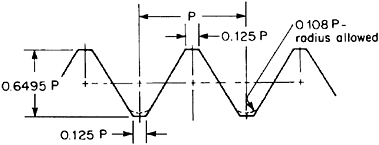 Figure 4.8.1: Unified national thread.
 There are three common thread classes in the unified system. Class 1 has the loosest fit and the broadest dimensional tolerances, Class 2 is the most common class for fasteners with closer fits and tolerances, and Class 3 is for more precise or critical applications. The letter A designates external threads and the letter B internal threads.
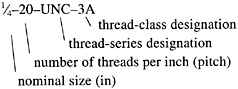
The standard method for designating a screw thread is to specify in sequence the nominal size, number of threads per inch, thread-series symbol, and thread-class symbol, supplemented optionally by pitch diameter and its tolerance. An example of an external thread designation and what it means is
The square thread form (see Fig. 4.8.2) is the most efficient form for the transmission of power. However, it is more expensive to produce than other forms and has been largely superseded by the Acme thread form.
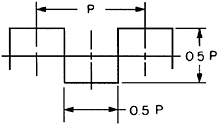 Figure 4.8.2: Square thread.
 Acme threads (see Fig. 4.8.3) are also used for power transmission and are easier to manufacture than square threads, but their power-transmission capabilities are slightly lower. Some valve stems and many lead screws...

 TABLE OF CONTENTS