Design for Manufacturability Handbook, Second Edition

Contour sawing is a band-sawing process. A multiple-tooth cutter, made from an endless band of sheet steel with cutting teeth on one edge, is power-driven across the workpiece. The workpiece rests on a horizontal table, and the band moves vertically in a downward direction. The work is fed either manually or with power assistance against the blade, and depending on how the work is guided, a straight or a curved cut is made as the blade advances into the work. For both conventional manually fed models and machines equipped with a servofeed attachment for heavier work, curved cuts are controlled visually as the operator follows a line on the workpiece. CNC and optical tracer control are also sometimes employed.
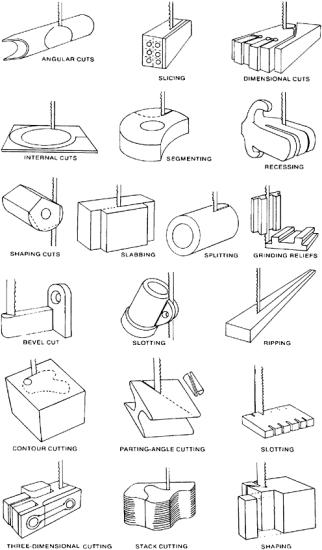
Machines employ an open-yoke C-shaped frame. The table may be stationary or, for larger work, movable. A third type of machine for large work is of radial-arm design; the entire C frame pivots and moves forward and backward. See Fig. 4.10.1 for the range of contour-sawing operations.
Saw bands are of either carbon or high-speed steel. Carbide-tooth inserts also can be used; the teeth are offset to provide clearance for the band, especially when curves are being cut.
When a quantity of thin parts is to be cut, it may be advisable to stack a number of blank sheets and cut the parts simultaneously.
By operating a band saw at extremely high...