Design for Manufacturability Handbook, Second Edition

Chapter 4.6: Parts Produced on Milling Machines

Theodore W. Judson

GMI Technical and Management Institute
Flint, Michigan

MILLING-MACHINE PROCESSES

The material-removal process intended to produce plane, form, or profile surface geometry by a rotating cutter is termed milling. Normally, the rotating spindle and cutter remain stationary, and the workpiece moves in the X, Y, or Z axis.

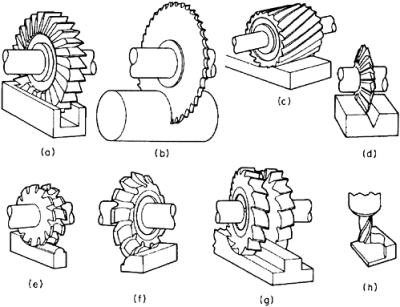
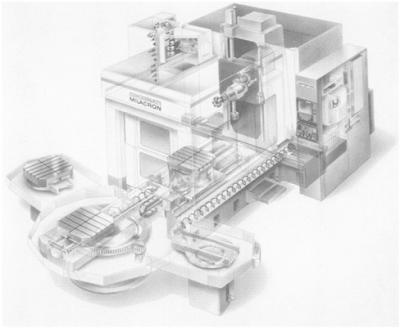
Process operations such as broaching, planing, grinding, and shaping are competitors of milling because these too can produce plane and form geometric surfaces. Milling cutters can be classified by two principal cutting actions: those which remove material by cutting on the side and those whose cutting action may be described as end cutting in addition to side cutting. Common types of milling cutters and typical operations are shown in Fig. 4.6.1. Figure 4.6.2 illustrates the development of a milling machine into a present-day computer-controlled machining center. Figure 4.6.3 shows a production machine convertible to either vertical or horizontal operation.


Figure 4.6.1: Types of cutters and typical milling operations. ( a) Slotting with a straight-tooth side-milling cutter. ( b) Slotting with a concave slitting saw. ( c) Plain milling. ( d) Angle milling. ( e) and ( f) Form milling. ( g) Straddle milling. ( h) Profile milling with an end mill. ( Courtesy Niagara Cutter, Inc.)

Figure 4.6.2: The modern development of the milling machine. This computer numerically controlled machining center can perform a variety of milling and boring operations automatically on a series of identical...

UNLIMITED FREE
ACCESS
TO THE WORLD'S BEST IDEAS

SUBMIT
Already a GlobalSpec user? Log in.

This is embarrasing...

An error occurred while processing the form. Please try again in a few minutes.

Customize Your GlobalSpec Experience

Category: Milling Cutters
Finish!
Privacy Policy

This is embarrasing...

An error occurred while processing the form. Please try again in a few minutes.