Design for Manufacturability Handbook, Second Edition
Edward C. Zuppann
Meehanite Worldwide Division
Meehanite Metal Corporation
White Plains, New York
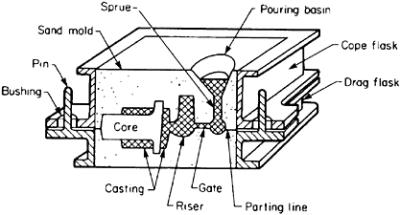
The making of a casting starts with the making of a pattern of the part to be cast. A refractory mold is then made from this pattern. The pattern is removed from the mold for reuse, and the cavity left by the pattern is filled with molten metal. When solid, the metal is the shape of the part. Figure 5.1.1 illustrates a mold as it would appear in a section view just after the metal has been poured.
The pattern is usually of wood for low production quantities, of aluminum for intermediate quantities, and of hard ferrous metals for high production. The sand refractory is usually a mixture of high purity: silica sand, bentonite clay, organic addi- tives, and water. This mixture is formed around the pattern by ramming and squeezing. Larger molds are dried to some degree before pouring. After the refractory has been compacted or chemically hardened, the mold is opened at a prearranged parting location and the pattern removed. Often the mold halves are made separately by using part of the pattern for each half. Accurate, strong sand components, called cores, are placed in the mold cavity to produce holes and internal cavities in the casting. The two halves of the mold...