Design for Manufacturability Handbook, Second Edition
Chapter 4.9: Broached Parts

Robert Roseliep

General Manager
General Broach and Engineering Co., Inc.
Chesterfield, Michigan

THE PROCESS

Broaching is the cutting of a machinable material by passing a cutter with a series of progressively stepped teeth over or through it. These teeth travel in a plane parallel to the surface being cut and, by removing a predetermined amount of stock, produce precision contours and finishes.

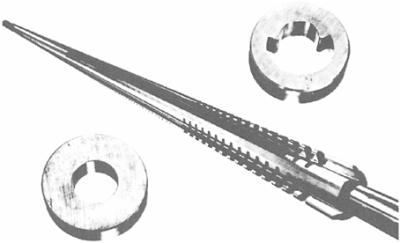
Most often, all the cutting teeth will be contained in one tool, known as a broach, to rough-out and finish-cut the part completely in a single machine stroke. (See Fig. 4.9.1.) When excessive stock prevents a one-stroke application, additional strokes can be employed, utilizing the same tool, if possible, or a series of tools. The location of the tool in relation to the workpiece must be changed by an amount equal to the stock removed on each stroke if the same tool is used for multiple strokes. The broach can be pulled or pushed and can be vertical or horizontal.


Figure 4.9.1: Complex-form pull broach showing the part blank before broaching and the finished configuration after pulling the broach through the part. ( Apex Broach & Machine Co.)

External Broaching

This method involves machining an external surface of the part. The workpiece is usually clamped in a holding fixture and the tool secured in a broach holder. Either the broach holder or the fixture is attached to the powered slide of a broaching machine, and the other is held in a fixed position relative...

UNLIMITED FREE
ACCESS
TO THE WORLD'S BEST IDEAS

SUBMIT
Already a GlobalSpec user? Log in.

This is embarrasing...

An error occurred while processing the form. Please try again in a few minutes.

Customize Your GlobalSpec Experience

Category: Broaching Machines
Finish!
Privacy Policy

This is embarrasing...

An error occurred while processing the form. Please try again in a few minutes.