Dielectric Resonators, Second Edition
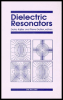
With renewed interest in dielectric resonator technology for modern wireless communications equipment, this book is an excellent reference for its understanding and application.
 TABLE OF CONTENTS
 Darko Kajfez
Reducing the cost of microwave circuits goes hand in hand with reducing their size. In this respect, microstrip and stripline have been essential in eliminating bulky waveguides and rigid coaxial lines in a great majority of microwave systems. Only in a few and very demanding applications, such as high power transmission, or low-loss filtering, are waveguides still being used. A more recent advance in miniaturization of microwave circuits has been the appearance of the low-loss temperature-stable dielectric resonators. These dielectric resonators are used to replace waveguide filters in such demanding applications as satellite communications where microstrip and stripline resonators cannot be used because of their inherently high losses. Furthermore, carefully designed microwave oscillators which utilize dielectric resonators can equal the temperature stability of conventional microwave resonant cavities machined from invar.
Handbooks and textbooks on microwave devices often devote many pages to the theory of hollow resonant cavities, but they provide little information on cavities containing dielectric resonators. On the other hand, the analysis and design of dielectric resonators are discussed extensively in many professional journals and conferences. The present book attempts to bring this knowledge together in an organized manner.
The size of a dielectric resonator is considerably smaller than the size of an empty resonant cavity operating at the same frequency, provided the relative dielectric constant of the material is a number substantially larger than unity. Only recently, materials having a dielectric constant between 30 and 40 with good temperature stability and low dielectric losses have become...