Dielectric Resonators, Second Edition
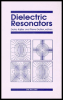
With renewed interest in dielectric resonator technology for modern wireless communications equipment, this book is an excellent reference for its understanding and application.
 TABLE OF CONTENTS
 and

The mode matching procedure described in Sec. 5.2 is valid for partial regions with any number of dielectric layers provided that the eigenvalues ? n and the corresponding eigenfunctions Z n for both the TM and TE cases are available. In this appendix, we solve the eigenvalue problems (5.22) and (5.46) in the case of a partial region with three dielectric layers (Fig. 5.2), which will allow us to consider a dielectric resonator on a substrate (Fig. 5.1). The results can be readily specialized to the simpler case of a region with two layers, such as partial regions 1 and 3 in Fig. 5.1.
We first turn attention to the eigenvalue problem (5.22). Since within each dielectric layer the eigenfunctions will have different functional forms, it is convenient to introduce the notation:
| (5.A1) | 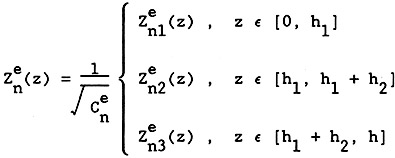 |
where  are normalization coefficients chosen to render the eigenfunctions orthonormal with the inner product (5.23). It is now easy to see from (5.22a) that in the kth layer, where k = 1,2, or 3, the function
 must satisfy the equation:
| (5.A2) |  |
where ? k is the relative dielectric constant of kth layer (cf. eq. (5.24)). In view of (5.22b),  and
 must also obey the boundary conditions:
| (5.A3) |  |
| (5.A4) |  |
From (5.16a) and (5.16b), we see that the continuity of tangential magnetic field across the interfaces between the dielectric layers demands that
| (5.A5) |  |
| (5.A6) |  |
Similarly, in view of (5.17a)...