Dielectric Resonators, Second Edition
With renewed interest in dielectric resonator technology for modern wireless communications equipment, this book is an excellent reference for its understanding and application.
 TABLE OF CONTENTS
 Donald F. Hanson
Resonators are important components in microwave communication circuits. They create, filter, and select frequencies in oscillators, amplifiers, and tuners. Fields inside a resonator store energy at the resonant frequency where equal storage of electric and magnetic energies occurs. The input impedance at resonance is purely real since the reactance is proportional to the difference between electric and magnetic energy storage.
The Q factor is an important figure of merit for a resonant circuit. The Q factor relates a resonant circuit's capacity for electromagnetic energy storage with its energy dissipation through heat. Microwave Q factors can be as high as 10,000. At lower frequencies, the Q factor is usually between 50 and 500. Resonator bandwidth is inversely proportional to Q factor. Thus, high Q factor resonators have narrow bandwidths. Resonators and the Q factor and its measurement are discussed in this chapter.
The figure of merit for assessing the performance or quality of a resonator is the quality factor, Q, which is a measure of energy loss or dissipation per cycle as compared to the energy stored in the fields inside the resonator. Q factor is defined by
| (2.1) | 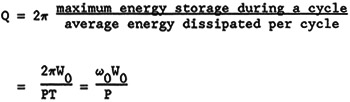 |
where W 0 is stored energy, P is power dissipation, ? 0 is resonant radian frequency, and T is period = 2 ?/ ? 0.
Some properties of resonators can be examined by starting with the differential equation for a simple resonator circuit:
| (2.2) | 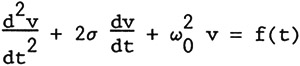 |
This can be obtained by proper...