Dielectric Resonators, Second Edition
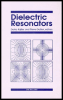
With renewed interest in dielectric resonator technology for modern wireless communications equipment, this book is an excellent reference for its understanding and application.
 TABLE OF CONTENTS
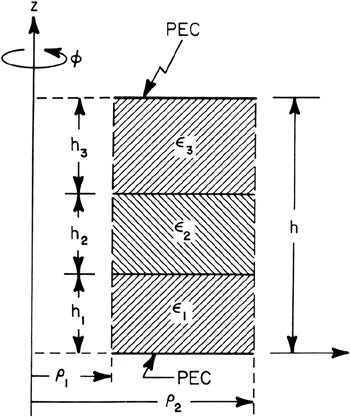
 In the radial mode matching method, the resonator cross section is divided into complementary regions, as indicated in Fig. 5.1. We observe that in each region the permittivity is independent of ?, i.e., ? r = ? r(z). In fact, ? r is a piecewise-constant function of z. A typical region with three dielectric layers is illustrated in Fig. 5.2. We seek to represent the field in each partial region as a superposition of TM and TE constituents which individually satisfy the boundary conditions at the PEC plates. We note from (5.11) that the magnetic vector potential with only a z component will generate field TM to  . Hence, we postulate
| (5.14) | 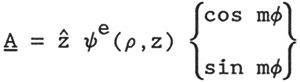 |
which reduces (5.13) to the scalar equation:
| (5.15) |  |
Upon substituting (5.14) into (5.11) and (5.12), one can express the magnetic and electric field components in terms of ? e as
| (5.16a) | 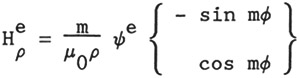 |
| (5.16b) | 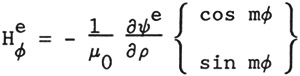 |
| (5.16c) |  |
| (5.17a) | 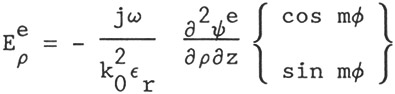 |
| (5.17b) | 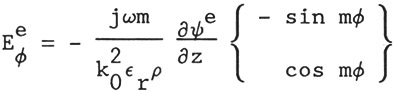 |
| (5.17c) |  |
As anticipated, the potential (5.14) generates a TM field, which is sometimes termed an E field (hence, the superscript e on ? and the field components). Since E ? and E ? must vanish on the PEC plates, we have from (5.17):
| (5.18) |  |
Also, if a region is adjacent to a cavity wall, we require that
| (5.19) |  |
where c is the radius of the cylindrical shield. If c = ? (parallel-plate waveguide), we replace (5.19) by the radiation...