Dielectric Resonators, Second Edition
With renewed interest in dielectric resonator technology for modern wireless communications equipment, this book is an excellent reference for its understanding and application.
 TABLE OF CONTENTS
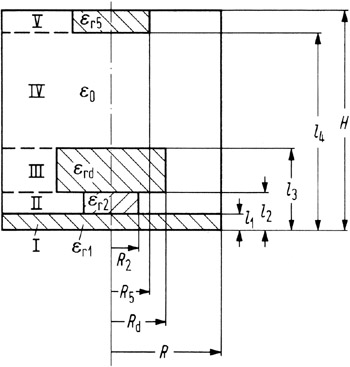
 The radial mode matching method described in detail in the previous section is based on the partition of the resonator cross section into partial regions in which the permittivity ? r is independent of the radial coordinate ? (Fig. 5.1). Each partial region is then considered as a section of a dielectrically loaded radial waveguide. In a complementary procedure, which will be referred to as the axial mode-matching method, the resonator is divided into partial regions in which ? r is independent of the axial coordinate (i.e., z), as illustrated in Fig. 5.3. It is noted that all partial regions so defined may be regarded as sections of dielectrically-loaded (regions II, III, and V) or homogeneous (regions I and IV) cylindrical waveguides. Therefore, the transverse fields in each partial region i, i = I,...,V, can be expanded in terms of cylindrical waveguide modes as [19]
| (5.92a) |  |
| (5.92b) |  |
where  are the modal propagation constants,
  and
and  are the transverse field expansion functions, and
  and
and  are the field coefficients. At a given frequency, the propagation constants
  must be found from a transcendental equation involving Bessel functions of order m and their derivatives, obtained by enforcing the continuity of the tangential field components inside each partial region and the condition of vanishing tangential electric field on the metallic enclosure.