Dielectric Resonators, Second Edition
With renewed interest in dielectric resonator technology for modern wireless communications equipment, this book is an excellent reference for its understanding and application.
 TABLE OF CONTENTS
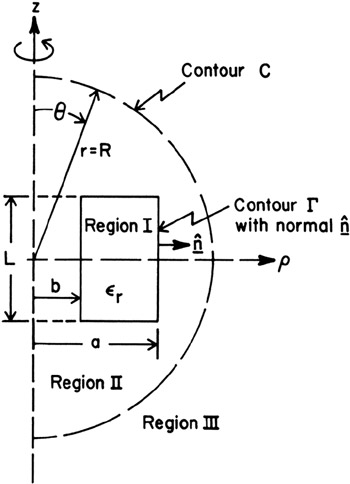
 In discussing the perturbational-asymptotic series technique, we will refer to the ring dielectric resonator illustrated in Fig. 5.4 (of which the pillbox is a special case). Only one half of the meridian cross section of the rotationally symmetric structure is shown in the figure. The DR resides in free space and is characterized by the relative dielectric constant ? r. It will also be convenient in the subsequent discussion to also introduce the index of refraction N as
| (5.107) |  |
The meridian plane is subdivided into regions I, II, and III, as illustrated in the Fig. 5.4. It should be noted that regions II and III have the same dielectric constant of free space, hence the circular boundary C separating them is merely an artifice introduced in the analysis.
We will limit attention to the axisymmetric TE modes. Hence, putting ? = E ? and referring to (5.97c), we see that ? must satisfy
| (5.108a) |  |
| (5.108b) |  |
In addition to satisfying (5.108), a and ? ?/ ?n must be continuous on the generating contour ?, which has an outward normal  . Also, ? must be zero on the z-axis and at infinity. Equations (5.108), subject to these boundary conditions, constitute an eigenvalue problem, which must be solved for the resonant wave number k and the corresponding modal function ? (the number of such solutions is infinite, but we will be only interested in...