Dielectric Resonators, Second Edition
With renewed interest in dielectric resonator technology for modern wireless communications equipment, this book is an excellent reference for its understanding and application.
 TABLE OF CONTENTS
 Darko Kajfez
In this chapter, we will take a closer look at the imperfections occurring in dielectric resonators. The two major imperfections are (i) the losses within the dielectric and (ii) the temperature dependence of the mechanical and electrical properties of the dielectric. Each of the two is of great significance because they impose limits on the two most important properties of dielectric resonators: the high Q factor and the high temperature stability.
Inside an isotropic dielectric material which also has a non-vanishing conductivity ?, the Maxwell equation for time-harmonic variation is expressed as
| (7.1) |  |
The finite conductivity ? is an obvious reason for losses, namely, for converting electromagnetic energy into heat.
Another mechanism which produces losses in the dielectric material at microwave frequencies is the damping caused by the alternating polarization of material exposed to the time-harmonic electric field. These losses may be expressed by defining a dielectric constant which is a complex number [1,2]:
| (7.2) |  |
In such a notation, (7.1) becomes
| (7.3) |  |
It can be seen that ?' takes the role of a traditional dielectric constant, and the total losses are caused partially by ?" and partially by ?. The loss tangent is defined as the ratio of the imaginary part to the real part in brackets above:
| (7.4) | 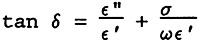 |
At microwave frequencies, the first part of expression (7.4) is dominant. Typically, ?' is constant and ?" grows with frequency.
It should be noted that the symbol ?